


Zero Trust Quick Wins: From Overwhelm to Action for SMBs
Zero Trust has evolved from a buzzword into a must-have security strategy for organizations of all sizes. Yet for many small and mid-sized businesses (SMBs) and compliance teams, it can feel overwhelming. This was a hot topic at the Gartner Security & Risk Management Summit 2025, where a session on “Zero Trust Quick Wins for Immediate Impact” caught my attention (gartner.com). The key takeaway? Most organizations already have the tools they need to start their Zero Trust journey – what’s missing are clarity, scope, and action. In other words, you don’t need to “boil the ocean” or wait for a perfect plan; you can begin with focused quick wins that deliver immediate benefits without massive resources or time (gartner.com).
In this post, I’ll reframe those Summit insights into practical steps, in my own voice, for SMB tech leaders, compliance teams, and even my clients on Upwork. These insights blend hands-on tactics with higher-level strategy. The goal is to help you kickstart Zero Trust in a manageable way, scoring some early wins that build momentum. Spoiler: You probably already have what you need to get started today.
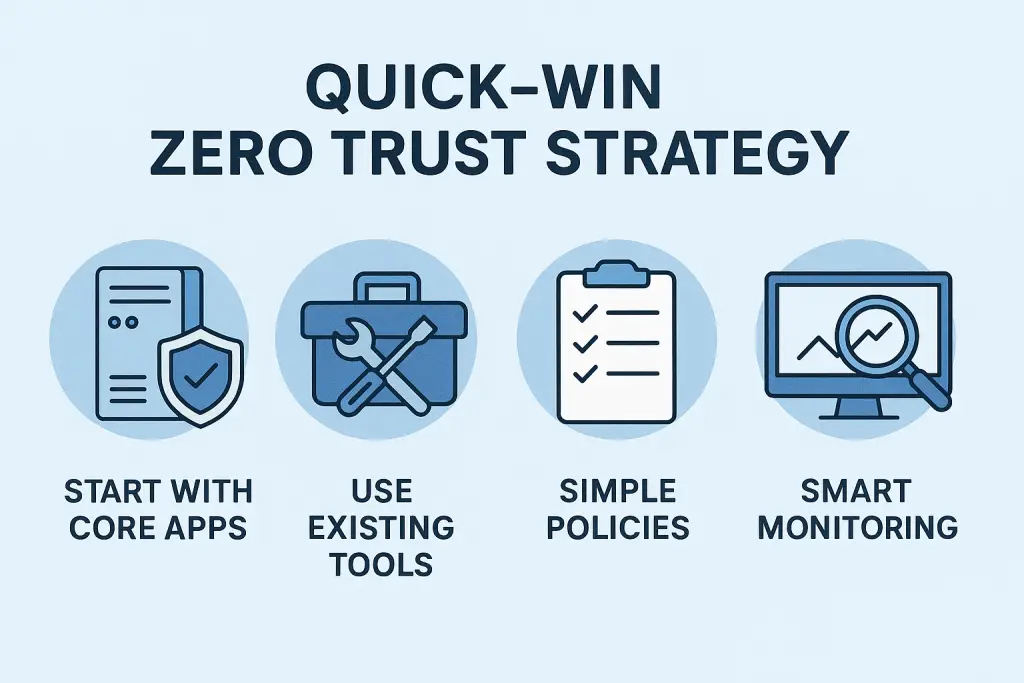
Start with Core Applications (Scope What Matters First)
One of the biggest mistakes in Zero Trust implementations is trying to apply it everywhere at once. Instead, focus on your core applications and data first – the systems most critical to your business. Identify your “crown jewels” (finance systems, customer data, key SaaS apps, etc.) and make them the starting point for Zero Trust controls. By narrowing scope to what matters most, you reduce complexity and see impact faster (cloudsecurityalliance.org).
For example, if you run a small ecommerce business, your core app might be the customer order database or payment system. For a professional services firm, it might be your project management or client portal. Begin by enforcing strict access to that one high-impact application: ensure only the right people (with MFA enabled) can access it, from trusted devices and locations. It’s okay if other less critical systems aren’t Zero Trust yet – you’re prioritizing the highest risks and value first (cloudsecurityalliance.org). This “protect surface” approach means you address the most vital areas without getting lost in securing every trivial asset on day one.
Strategically, starting small actually accelerates long-term progress. As the Cloud Security Alliance notes, “Start small with manageable, quick wins to build momentum. Prioritize use cases that protect your most critical [assets]” (cloudsecurityalliance.org). Early success with a core app not only reduces immediate risk but also proves to stakeholders that Zero Trust works, which can justify broader efforts later. It’s much easier to expand your security program after demonstrating value in one area than to pitch an all-or-nothing mega project upfront.
Internal Tip: If your organization follows frameworks like NIST or CIS, map your core app focus to those requirements. For instance, if customer data protection is a compliance requirement, showing enhanced controls on that CRM system hits both Zero Trust and audit checkboxes. Starting with core apps aligns security with business priorities – a win-win that leadership and compliance officers will appreciate.
Leverage the Tools You Already Have (No “Big Bang” Purchase Needed)
Another encouraging insight: you likely already own the tools to implement Zero Trust fundamentals. Many SMBs hear “Zero Trust” and assume they need to buy an expensive new solution. In reality, core Zero Trust principles – verifying identity, enforcing least privilege, segmenting access – can often be achieved with existing infrastructure. Before ripping and replacing, take inventory of your current security stack and features.
Do you have a firewall or VPN with segmentation capabilities? An identity provider (Azure AD, Okta, etc.) that supports conditional access or multi-factor auth? Endpoint security software that can enforce device compliance? Chances are, you do – but maybe you’re not fully utilizing those features. According to SANS Institute, most organizations have “excellent products that simply aren’t configured in an effective way or aren’t being operated to maximize their capabilities” (sans.org). In fact, a first step in Zero Trust is often reconfiguring and optimizing what you already own (sans.org).
For example, you might use Microsoft 365 or Google Workspace – these platforms have built-in tools for Zero Trust-like controls (conditional access policies, device management, data loss prevention). Similarly, many next-gen firewalls can do internal segmentation or identity-based policies. Rather than immediately shopping for new “Zero Trust” branded products, see how you can repurpose your current tools as enforcement points. This saves cost and speeds up implementation. As one blog put it, “Understanding how to leverage an organization’s current infrastructure and incorporating those existing technologies into the Zero Trust plan are the first steps toward building a truly defensible security architecture” (sans.org).
Real-world quick win: enable MFA on your critical apps using your existing identity provider – no need to buy a separate solution if you already pay for Microsoft 365 or similar which includes MFA. Or, take your firewall and set up network segments isolating that core application from the rest of the network (many firewalls support VLANs or zones out of the box). Use what you have, before you acquire new tools. This approach isn’t just practical; it’s supported by industry experts. The SANS Institute notes that both government and commercial entities can “fully leverage the tools they already have when embarking on their Zero Trust journey,” which saves time and money (sans.org). You can always fill gaps with new solutions later, once you’ve squeezed value from your current investments (sans.org).
Keep Policies Simple and Actionable (Clarity Over Complexity)
Zero Trust is ultimately enforced through policies – rules about who/what can access which resource under what conditions. It’s tempting to design ultra-granular policies covering every edge case. Resist that urge, especially at the start. Quick-win Zero Trust policies should be straightforward enough that your team can actually implement and maintain them. Focus on clarity and executability.
What does a simple Zero Trust policy look like? Here are a few examples:
- Single-App Access Policy: “Only Finance Team members with up-to-date devices can access the finance system; all access requires MFA and is logged.” This one policy encapsulates identity, device, and authentication requirements in plain language.
- Network Segmentation Rule: “The CRM database server only accepts traffic from the application server and nothing else.” A clear rule that enforces a strict allowlist, easy to monitor.
- Least Privilege Role: “Customer Support reps can view order info but cannot export data or change system settings.” This defines a role with just-enough access, which is a core Zero Trust tenet.
Notice these examples are not lengthy or full of technical jargon. They’re concise, enforceable statements aligned to business roles and critical assets. By keeping policies at a high level of clarity, you make it easier for IT admins to translate them into configurations (firewall rules, IAM roles, etc.) without error. You also make it easier to communicate to employees and auditors what controls are in place. A policy that’s 50 pages of dense technical detail might satisfy a theoretical model, but if it can’t be operationalized by your small IT team, it’s not a quick win – it’s a paper tiger.
When crafting your Zero Trust starter policies, aim for “minimum viable security” that still significantly reduces risk. It’s perfectly fine if your initial policies leave some scenarios unaddressed; you can iterate and tighten over time. The important part is to create policies you can take action on immediately – the 80/20 rule applies. Cover the 20% of rules that mitigate 80% of your risk. For instance, one or two well-thought-out access rules on a critical app (as above) can eliminate large swaths of vulnerability, even if a few low-risk cases remain less controlled in the short term.
This pragmatic approach was echoed in the Summit session: quick wins are about doing what’s effective and doable now versus chasing perfection. If your policy is too complicated to implement with your current tools or expertise, simplify it until it fits your reality. You can build sophistication as you mature. Remember, Zero Trust is a journey; your policy can evolve as your capabilities grow.
Monitor Smart, Not Everything (Focus on High-Value Signals)
“Never trust, always verify” is a core Zero Trust mantra – which naturally puts emphasis on monitoring and verification. However, a quick-win mindset means you shouldn’t try to monitor absolutely everything on day one. That’s a recipe for alert fatigue and burnout. Instead, monitor smart. Focus your logging and alerting on the areas that matter most to your newly protected core applications and policies.
Continuing our example of starting with one core app – say your finance system – identify the key events that would indicate something’s wrong or someone’s poking where they shouldn’t. For instance:
- Multiple failed login attempts (could indicate a brute force attack or stolen credentials).
- A login to the finance system outside of business hours or from an unusual location/device.
- An account in the Finance role trying to access data or features they never use.
- Any changes to the finance application’s configurations or user permissions.
By setting up alerts for a handful of these high-risk signals, you get meaningful security visibility without drowning in noise. Modern security tools like EDR/XDR, User Behavior Analytics (UEBA), Network Detection & Response (NDR), or even your SIEM can be configured to watch for such anomalies. If you have a small team, you might leverage built-in alerting from your SaaS providers – for example, Microsoft 365 can alert on suspicious sign-ins automatically if tuned, and many cloud services have similar security alerting features. Use them! They are likely included in what you’re already paying for.
The point is to be selective and intelligent in monitoring, especially at first. As one industry article put it, start by monitoring “core applications and fine-tune alerts to avoid unnecessary noise” (okoone.comokoone.com). It’s better to reliably catch the 5 most critical issues than to set up 500 alert rules that you’ll never have time to investigate. Over-monitoring everything will either overwhelm a small IT/security team or lead to important warnings getting lost in a sea of trivial logs.
Over time, as you win more resources or adopt more advanced tools, you can broaden your monitoring. But early on, match your monitoring scope to your policy scope. If your Zero Trust effort is focused on the finance app and its user access, channel your logging and analytics there. This approach aligns with the “quick win” philosophy by providing immediate value – you’re likely to catch real issues in the most critical area – and it proves the concept of Zero Trust’s “verify everything” without overtaxing your team.
From Quick Wins to Long-Term Strategy
By starting with a focused scope, using what you have, enforcing simple policies, and monitoring smartly, you create a foundation of Zero Trust that is achievable for an SMB or lean enterprise. These quick wins are tactical steps, but they ladder up to a bigger strategic shift: a culture that no longer implicitly trusts anything inside or outside the network. You’re demonstrating that security and business can move together incrementally. As Gartner’s session highlighted, this approach delivers immediate benefits and momentum, even if you feel behind the curve (gartner.com).
It’s worth noting that Zero Trust is quickly becoming the expected norm. In fact, 63% of organizations have already adopted Zero Trust Architecture in some formokoone.com, and regulators, insurers, and customers are starting to ask about it. By getting some quick wins on the board, you’re not only reducing risk but also showing leadership (and maybe prospective clients) that your organization is proactive and resilient. This can pay off in tangible ways, from cyber insurance premium reductions to winning business deals where security is a factor.
Remember that these initial wins are just the beginning. Zero Trust is a journey of continuous improvement. After securing one or two core applications, you can expand to others, iteratively refine policies, and introduce new controls as needed. But now you’ll be doing it with real experience and stakeholder buy-in, rather than theory. Each quick win builds confidence and competence in your team.
Placement & Internal Links: (For website use) This article is well-suited for our company’s Blog/Insights section, under a “Security Strategy” or “Zero Trust” category. We can internally link terms like Zero Trust (perhaps to a glossary or earlier intro post on Zero Trust principles), multi-factor authentication (to any post on MFA or an explainer), and security monitoring (maybe to a case study or service page about our monitoring solutions). For example, when mentioning MFA, link to our article on the importance of multi-factor auth for SMBs, and when discussing Zero Trust journey, link to our services or a prior post about Zero Trust planning if available. This helps readers explore related content and shows our expertise across these topics.
Conclusion: Take Action – One Step at a Time
If Zero Trust has been on your radar but not on your roadmap, now is the time to change that. You don’t need a Fortune 500 budget or a PhD in cybersecurity to get started. Pick one quick win from the above – just one – and make it your project for this quarter. Maybe that’s turning on MFA for a critical app, or writing a simple access policy for your finance system, or segmenting a database from the rest of the network. Rally your team, define what “done” looks like for that small step, and execute.
Then, observe the results. Did it reduce risk? Did you learn something about your systems or processes? Use that as fuel (and proof) for the next step. Zero Trust isn’t an all-or-nothing switch; it’s a series of deliberate moves that cumulatively harden your defenses. Each quick win is progress. As you string together these wins, you’ll find that the once-daunting “Zero Trust” concept becomes a natural part of how you operate.
Call to Action: Take a moment to reflect on your environment: What’s one critical asset you should never trust by default? What’s one thing you can do this month to better secure it? The answers to those questions are your quick wins waiting to happen. By focusing on clarity, scope, and action, you can start your Zero Trust journey immediately – no more waiting on perfect conditions. In my experience, the organizations that succeed in modern security are those that start somewhere and keep improving. You can do the same.
(P.S. To help jumpstart your journey, I’ve developed a lightweight Zero Trust Starter Policy template that SMBs can readily adopt. It distills the above principles into a clear company policy. Feel free to use the draft below as a starting point for your own organization.)